Mel, I cannot agree with you more. I particularly concur with your ideas about how arts integration can help to reconstruct the dynamics of classrooms which may be dominated by 'teacher-talk'. I think that arts integration and inquiry can truly hand over the ownership of knowledge and learning to the rightful owners - the students.
As you know, this week for Introduction to Arts Education the focus is on drama and we are required to provide an answer to the following question: "what strategies would you use in teaching a drama workshop to primary children"? I don't know about you, but what really resonated with me is the idea of process drama as a creative, experiential and expressive way of learning through drama. This is a new way of thinking about drama for me because as a child, I was educated to learn about drama and memorize lines. I am not, however, saying that this kind of drama does not have its own educational benefits (in such areas as communication, self-esteem, character exploration and "social dreaming" (Sinclair, Donelan, Bird, O'Toole & Freebody, 2009, pp. 65-100), but I am interested in the possibility of using process drama as a pedagogical approach in my classroom to allow my students and myself to negotiate meaning with the curriculum.
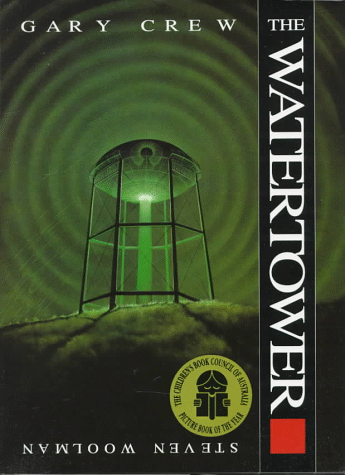 However, I have digressed. In answer to the aforementioned question, I will provide ideas of process drama strategies that I believe could be used to encourage students to engage with Gary Crew's The Water Tower. I would aim to include activities that encourage a combination of making, presenting and responding. Initially, I would take my upper primary students on a picture-walk through the text. I would use the activity of "Soundscape" to encourage students to make a soundtrack using everyday objects that conveys the feelings and emotions they derive from the highly evocative and eerie illustrations in The Water Tower. This activity presents a combination of the aforementioned making, presenting and responding. After reading the text, students would participate in a "Conscience Alley" activity where one student role plays the character of Bubba, other students for two lines and while Bubba moves through the 'alley' on side gives reasons and encourages him to come into the watertower, while the other line of students juxtapositions this. I believe this activity engages students in 'making'. Finally, students would also participate in a "Flashforward/Flashback" activity in small groups to negotiate and dramatise collaborative ideas about what happens/happened to the small town named Preston where The Water Tower is set 10 years before and 10 years after the events of the story. This activity requires both making and presenting
Until next week,
Steph
Teaching Tool-Kit
The activities I have mentioned above can be found at this exceptionally useful website.
References
Sinclair, C., Donelan, K., Bird, J., O'Toole, J., & Freebody, K. (2009). Drama: Social dreaming in the twenty-first century. In Sinclair, C., Jeanneret, N., & O’Toole, J. (Eds.). Education in the arts: Teaching and learning in the contemporary curriculum (pp. 65-100). South Melbourne, VIC: Oxford University Press.
Teaching Tool-Kit
The activities I have mentioned above can be found at this exceptionally useful website.
References
Sinclair, C., Donelan, K., Bird, J., O'Toole, J., & Freebody, K. (2009). Drama: Social dreaming in the twenty-first century. In Sinclair, C., Jeanneret, N., & O’Toole, J. (Eds.). Education in the arts: Teaching and learning in the contemporary curriculum (pp. 65-100). South Melbourne, VIC: Oxford University Press.

No comments:
Post a Comment